Its great to have people like Ken Robinson, Dan Pink commenting on the need for educational reform. It is surprising however to see the number of tweets, blogs and videos by teachers declaring these ideas as revolutionary. Robinson and Pink are suggesting today's curriculum needs to be radically changed, indeed they are looking for a paradigm shift in curriculum structure. Teachers have been arguing these points and demanding these reforms for many year, but nobody wanted to listen. In the past coupe of decades teachers have been expected to stand back in awe of captains of business and industry, after all we hadn't got proper jobs! I would have thought with an ounce of humility these same captains of industry would have had their tails between their legs after the financial fiasco's of last year. But oh no, not a bit of it. Not content with the privatisation of profit and the socialisation of debt, they have the cheek to start telling education what reforms are required.
During the 90's administrators in education adopted the information technologies that had successfully reformed business and industry. With the power of the database at their finger tips and the ability to move information from A to B and back again, school administration enjoyed a boom period. The success of the MIS laid the door open to the adoption of other business models, measures of efficiency, units cost, and models of accountability, After all if it was good for business it must be good for education.
Somewhere along the way we lost site of the fact that our unit of production was not uniform unvarying like some mass produced gadget. Rather our product was the finest, most diverse, most creative, innovative item on the planet, young people. How did this happen? How could we the teaching profession have been so short sighted? You know I think we were all seduced by the wonders of the new technologies.Information processing seemed to incredible, databases all knowing, statistics could be generated in an instant, how could it be wrong, how can you argue, we had data, we had numbers.
We didn't know it at the time but these 'new solutions' the MIS, would actually create sufficient inertia both in out schools that it would stifle the true reforms required of the classroom. The MIS did not reduce but actually increase the bureaucratic burden of the teacher. No doubt there where small victories along the way but these where small and local.
The MIS had a life of its own it became a monolith to progress, unstoppable, immovable. immense edifices to the system.
IT had championed administration but had singularly failed to deliver its promise of learning reforms.
Things changed.
Bill Cameron describes this as the 'democratisation of media', we might know it, as blogging, podcasting, or YouTube. Smartphones, iPhones, Tabs, Ipads, Laptops and other gizmo's.
We all know the rhetoric about the effect of the technology, we all know the potential, we all know where we want to go, the difference is that this time its happening.This time the tools actually work. Here just a few of the technology tools to reform your classroom
Now we have a new problem. Teachers are keen to adopt these technologies realising how they empower the learner. Education is nervous of the empowered student not to mention the empowered teacher. Teachers are unclear about which are the best tools and how these can be deployed. Time to trial and evaluate is limited by the huge bureaucracy generated by the MIS. But the tools do work. The real challenge is that this time business and industry cannot offer model of practice for us (or administrators) to follow. You see the rate of change in technology is so fast that it has caught out everybody. With changes in global economic circumstances the bubble for business and industry has burst. In the new markets out sourcing has left business and industry scratching their heads about how to market. Slowly but surely they are realising that a new strategy is required, one in which the customer is valued and cherished, the personal touch is required. Now they step onto the platform on which teachers have been performing for years. Teachers invest in their students with no though for profit, teacher rapidly evaluate and assimilate new methodology to meet the changing needs of those in their care. This time teacher can lead the way, and business and industry would do well to observe.
Watch out business and industry you might learn something form the professionals
It's cool to achieve
John
Friday, November 19, 2010
Nearly 400,000
I remember the days when click4biology used to attract about 20 visitors a week.
Now 20 visitors in an hour is poor.
Looks like we will hit 400,000 very soon and in 2011 we may even hit the half million visits.
Not much compared to some sites but pretty good considering the potential audience.
Click on the homepage globe to see the wide distribution of click4biology users, its amazing.
I'm so please to see the growing numbers of users from African countries, the word is spreading there.
Please drop us a line on the Wallwisher link
best regards
it's cool to achieve
John
Now 20 visitors in an hour is poor.
Looks like we will hit 400,000 very soon and in 2011 we may even hit the half million visits.
Not much compared to some sites but pretty good considering the potential audience.
Click on the homepage globe to see the wide distribution of click4biology users, its amazing.
I'm so please to see the growing numbers of users from African countries, the word is spreading there.
Please drop us a line on the Wallwisher link
best regards
it's cool to achieve
John


Beware Paradigmians bearing gifts
Beware of education reformist advocating wholesale reorganisation of our school curriculum.
Their evangelical message is seductive.
Their message is that you (the school) are killing creativity(and teachers are applauding)!
Their message is that in a Google World we no longer need content.
They are wrong!
Without content you have no context.
Mastering the content and becoming an expert in the signature disciplines allows one to find context.
The Google World simply provides a tool which allows greater access to the content and so to your best synthesis.
As Gardner has then explained it is at this point, with contextual knowledge and conceptual understanding that Creative thinking can occur.
Creativity is not thinking outside the box, its thinking on the outer edges of the box, where innovation has context and value.
Those who advocate ditching the content are advocating innovation without context, chaos.
Resist.
Their evangelical message is seductive.
Their message is that you (the school) are killing creativity(and teachers are applauding)!
Their message is that in a Google World we no longer need content.
They are wrong!
Without content you have no context.
Mastering the content and becoming an expert in the signature disciplines allows one to find context.
The Google World simply provides a tool which allows greater access to the content and so to your best synthesis.
As Gardner has then explained it is at this point, with contextual knowledge and conceptual understanding that Creative thinking can occur.
Creativity is not thinking outside the box, its thinking on the outer edges of the box, where innovation has context and value.
Those who advocate ditching the content are advocating innovation without context, chaos.
Resist.
Thursday, November 18, 2010
Presenting at the Beijing Learning Conference
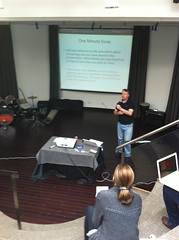
More photographs and videos from Brian Lockwood
Now back in Thailand at the Bangkok Patana Theory of Knowledge residential.
The event is now coming to an end and the students are pretty tired.
Wednesday, November 17, 2010
Don't wait for management.
Waiting for management to follow you, you're wasting time.
Waiting for your boss to read the blog that's inspired you, you're wasting time.
Waiting for management to recognise your brilliance, you're wasting time.
Waiting for your line manager to watch the same TED talk or YouTube, you're wasting time.
Waiting for management to recognise your brilliance, you're wasting time.
Waiting means you'll miss the window of opportunity.
Cause change,
make a difference,
be a leader.
Others will follow.
Waiting for your boss to read the blog that's inspired you, you're wasting time.
Waiting for management to recognise your brilliance, you're wasting time.
Waiting for your line manager to watch the same TED talk or YouTube, you're wasting time.
Waiting for management to recognise your brilliance, you're wasting time.
Waiting means you'll miss the window of opportunity.
Cause change,
make a difference,
be a leader.
Others will follow.
Thinking outside the box
 The road to creativity
Proceed quickly along the established route
At the junction with the road less travelled take this as your preferred option
At the end of this road.....
Ah well now you are on your own
You may need to proceed on foot
Two roads diverged in a wood and I – I took the one less traveled by, and that has made all the difference.
-Robert Frost
Tuesday, November 16, 2010
Using IT in the Biology class
Last week I was the guest of the Western Academy of Beijing (WAB) for the Beijing Learning Summit. As part of my visit I was able to observe different teachers in different Beijing school all trying to use IT in their lessons.

Some schools had a wealth of IT hardware other less so. Yet beyond the technical aspect of how the tools work the pedagogical challenges are the same for all teachers. The main message seems to be to take the risk, try all the tools and find the one that fit your teaching style.
Here's a fuller account of the BLS by Gerard Dutton
Start with small changes and gradually, increase your IT tool kit. Mean while here's an interesting link to a Microsoft biology research resource

Some schools had a wealth of IT hardware other less so. Yet beyond the technical aspect of how the tools work the pedagogical challenges are the same for all teachers. The main message seems to be to take the risk, try all the tools and find the one that fit your teaching style.
Here's a fuller account of the BLS by Gerard Dutton
Start with small changes and gradually, increase your IT tool kit. Mean while here's an interesting link to a Microsoft biology research resource
Subscribe to:
Posts (Atom)